ALPHA




Commanders, it is with enormous excitement, and a fair bit of disbelief that we are finally writing this post, that we can announce Beyond All Reason has officially signed a publishing partnership with Hooded Horse and is going professional!
Almost seven years of community-driven development, more than 150 contributors pouring incredible amounts of time and care into this project, and a community that has grown into one of the most active in the entire RTS space. It is time to take it one step further and secure a successful release and longevity of the project for years to come.
If you have been following recent developments in our community channels, you may already know that we have been discussing a potential publishing deal internally with the Contributor Team. We realise this may come as a very unexpected shift to many of you, so we would like to take the utmost care to explain why we took this step, what it means for the future of the project, our development team, and the community.
For those of us on the admin team, this announcement has been a long time in the making. A lot of time went into conversations with publishers, lawyers, advisors, and our contributor team, trying to work out whether there was a way to take BAR to its full potential without compromising what makes it special. The honest truth is that for a while, we were not sure such a path existed. The fact that we are publishing this announcement at all, with a partner that genuinely fits and a structure that protects what BAR is at its core, still feels slightly surreal as we type this.
Without further ado, let us cut to the chase and break down what the Tick is going on!
TLDR: Read post summary
Many of you seeing this headline are probably immediately wondering about that.
After all, the volunteer-only model has carried Beyond All Reason to greatness. The game is doing well, the community is growing, we have just presented the lore and worldbuilding for the campaign, we are regularly releasing updates, and it can look like the project is already moving forward at a solid pace.
At the same time, anyone looking closely at our Steam Release Roadmap may notice that many of the biggest things we aspire to bring for release are still a long way ahead.
So where does this paradox come from? Why is the project so alive and actively moving forward, while the Steam release can still feel so far over the horizon?
The honest answer is that the volunteer-only model has a very specific character.
It is incredibly good at the work people are personally excited to do in their free time: new unit ideas, balance changes, beautiful maps, lore, gameplay experiments, events, tournaments, and countless other things that have made BAR what it is today. The amount of passion and craft this community has poured into the game over the years is genuinely remarkable.
But a full Steam release depends on a different kind of work: long, sustained, often unglamorous effort that has to be owned from start to finish. A new client, a coherent campaign, scalable, reliable infrastructure, onboarding, QA, polish, release coordination. None of these are impossible, but they require focused time, accountability, and people whose job it is to carry them through, not just contribute to the parts they enjoy after work.
That is the paradox. BAR is alive and moving fast because volunteers keep creating amazing things. The Steam Roadmap still feels far away because many of its biggest items are exactly the kind of work the volunteer-only model struggles to finish.
We have been hitting this wall for a long time, and we have tried many ways around it. Looking honestly at the road ahead, the volunteer-only path would likely put a proper Steam release another three to five years away from where we stood at the start of 2026.
We did not want to keep telling the community “soon” while knowing that, structurally, it was not entirely true.
The window for BAR to make a real impact in the RTS world is not eternal. We did not want to look back years from now at a game that was “almost ready”, knowing we had a chance to do this properly and chose not to.
At the same time, as may be a surprise to some and obvious to others, BAR has been getting noticed in the games industry for a while now. Over the past couple of years we have had a surprising number of publishers reach out to us with offers. It is an incredibly privileged position in today’s industry to be in, having so many options. Most we politely declined. The structure of a typical publishing deal is shaped around a particular kind of game and a particular kind of studio, and very little of that shape fits a project like BAR.
We did not want to fold ourselves into a model that would slowly chip away at what made BAR worth doing in the first place.
One offer, however, came in looking completely different. The shape of it was closer to what we would have asked for if we had been able to write our own dream contract than anything else we had seen, and the values behind it lined up with the spirit of the project in ways we had stopped expecting to find. So we dug in.
Before we get into what is actually in this deal and why it fits BAR so well, let us introduce the publisher!
If you play strategy games on Steam, you very probably already know their work. Hooded Horse is a publisher specialising entirely in strategy, simulation, and role-playing games, and their catalogue is a who's-who of recent indie hits in the genre: Manor Lords, HOMM: Olden Era, Terra Invicta, Against the Storm, Old World, and a long list of others.
What is interesting about Hooded Horse is how young the company itself actually is. Founded in 2019 by Tim Bender (CEO) and Snow Rui (President), the same year the modern incarnation of BAR development began, they have grown from a tiny operation into one of the most respected publishers in the strategy space in just a few years. The team is still relatively small at a little over 30 team members, with each member a specialist in a particular subgenre they personally play.
They have built one of the cleanest reputations of any publisher operating in this space, known for being hands-off on creative direction, unusually transparent about how they work, and genuinely respected by the developers they have partnered with. A meaningful part of that reputation comes from how their business model is structured. Hooded Horse pays developers from the first dollar of sales rather than trapping them in the recoupment cycle that still dominates a lot of indie publishing. Each game they take on gets a guaranteed marketing investment regardless of its commercial trajectory. The model is built around developer success rather than extraction. Having looked at a lot of publishing models over the past year, we can confirm this is genuinely rare in this industry.
After spending many months in discussions with Tim and the wider Hooded Horse team, also recently having them meet our Contributor Team we can say with full confidence this reputation carries through in how they approached our project and in what we put on paper.
Let's get straight to the questions everyone is going to ask and explain what this deal entails and what it means for BAR’s future.
The question many of you will be asking by now is "well, what's in it for the publisher?" BAR comes from a community-driven, open-source lineage, and has always been free. How do we turn it into a commercial venture without breaking the spirit of what we have built?
This is genuinely the most interesting part of the deal, and we were able to align on a monetisation model that historically has only been tried by a small handful of games.
The model we landed on with Hooded Horse is, in simple terms, this:
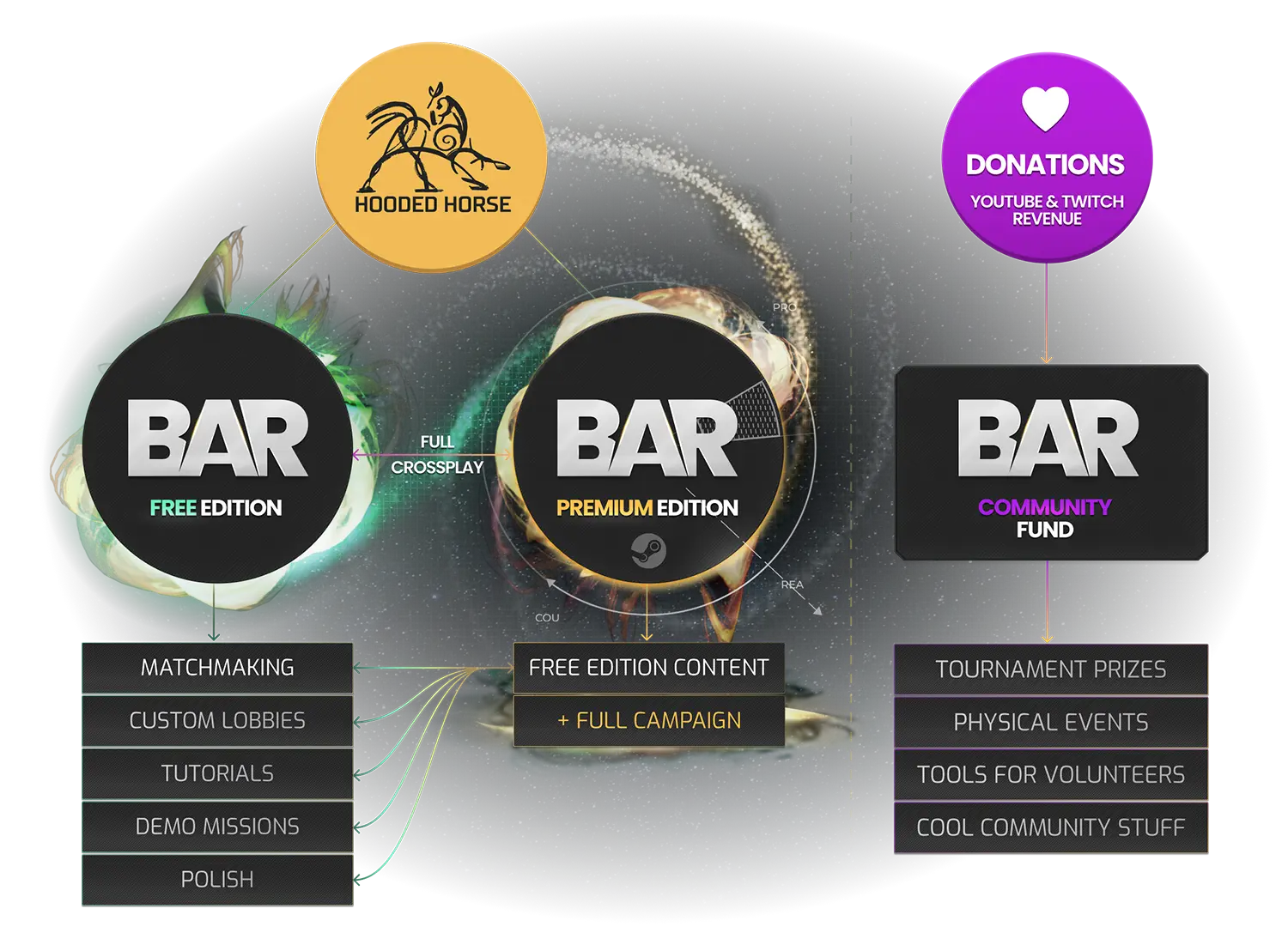
BAR’s multiplayer and all current content stays free exactly as available now through the website version. In addition, we’ll be using the funding from the publishing deal as well as revenue from sales to improve the multiplayer experience, with these improvements offered for free as well.
The Steam release will be paid, and aside from the multiplayer experience, it will also feature additional singleplayer content. The multiplayer game will be the same on Steam, with full feature parity and cross-play. Same matchmaking, same servers, same community-built content.
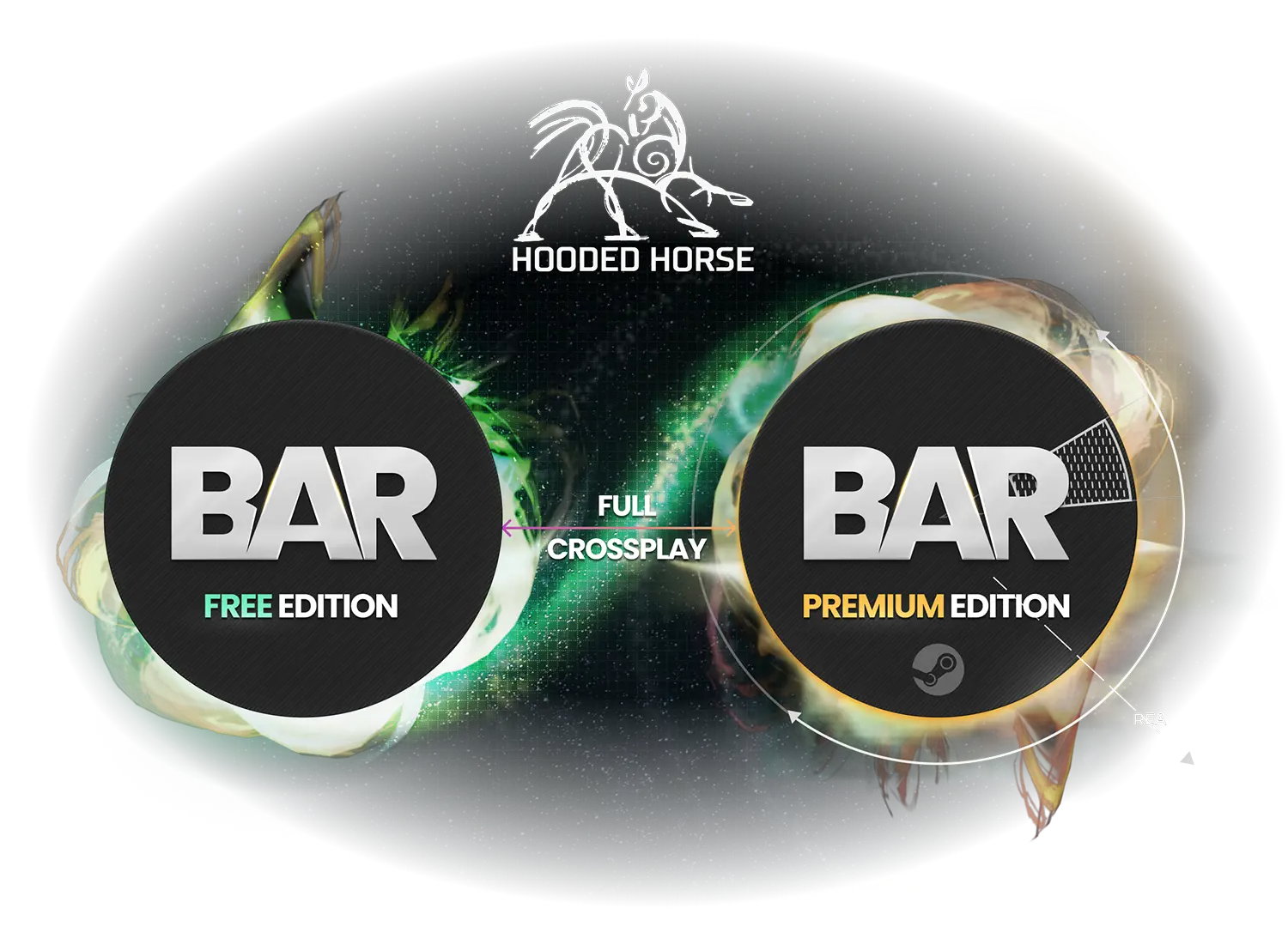
Nothing that is free today gets taken away or put behind a paywall, and what is free will be continuously improved as well.
And that part matters a lot. BAR is an incredible multiplayer game, and everyone here knows that, but a huge part of the RTS audience comes primarily for single-player. For many people discovering BAR on Steam, the campaign will be their first real impression of the game. We do not want that to be “a few scenarios with story text attached”. We want it to feel like a real campaign: coherent, atmospheric, story-driven, and worthy of the world we have been building.
We know some people expected BAR to remain completely free in every possible form forever, so we understand why this may feel like a big shift. We did not take that lightly.
The important part is that the funding does not only go into paid content. A lot of it goes into things that improve BAR for everyone: the new client, better infrastructure, visual polish, onboarding, matchmaking, tutorials, QA, localisation, accessibility, and a long list of other work that the whole game needs regardless of edition.
The free version becomes a much better game because this deal exists.
To be clear about the usual fears that come with anything commercial: we intend to base BAR around a premium sale price for the full game, and then any paid expansions that might come later would be substantial additional content, there is not going to be any pay to win, ad placements, or similar. We are gamers ourselves first, and we hate that stuff in the games we play as much as anyone reading this does. We are not going to do it to BAR. The closest reference point is probably Mindustry: a free open-source game kept intact, with a paid Steam version on top for people who want that route. We are taking a similar general shape, adapted to BAR and to the scale of what we want to build.
So if you have been playing BAR for free for a few days or for years and years, the short version is: nothing gets taken away.
You keep the game you already have, you benefit from the improvements made possible by the funding, and you can choose whether you want to go further with the Premium Edition to experience the full campaign or stay entirely on the free side.
The other unique aspect of the deal we were able to achieve is how it protects the future of the project as a community driven game:
Donations stay community-facing. Donations to BAR continue, walled off from the commercial side. They are being formalised as a community fund covering tournament prize pools, community events, contributor tooling, server safety net, and similar community-facing spending. The publishing funding covers commercial development. The two never mix. More on the community fund mechanism in a follow-up post.
The biggest practical change is that BAR development is going professional.
The publishing funding lets us hire full-time personel into the areas that have been bottlenecking the project for years: client and infrastructure work, campaign content production, project management, QA, polish, release coordination, and other roles that could never really be sustained on volunteer time alone.
Before signing, we wanted to be sure the funding actually matched the ambition. We now have the production plan and budget breakdown, and the answer is yes. There is enough funding to cover pretty much all of our main aspirations for the Steam release in a reasonable timeframe.
That is still a bit surreal to write. Six months ago, we could not have said this. We can’t wait to present the updated roadmap to the community! :)
A huge priority for us is making sure this transition does not lose what made BAR special in the first place. Wherever we need someone full-time and there is an existing contributor already doing great work in that area, that person is first in line. That has been our internal commitment from the start.
The volunteer side of BAR keeps going. People can still contribute in the same way they always have, on the parts they care about and enjoy working on. The funded side finally gives us a way to take on the heavy, continuous, deadline-sensitive work that has been waiting for proper ownership for a long time.
Before anything was signed, we put the deal in front of the people who build BAR.
Over several weeks, contributors read the proposal, discussed it in threads, joined voice meetings, asked Hooded Horse questions directly, challenged us on the parts they were uncomfortable with, and gave a lot of detailed feedback.
There was broad support for working with Hooded Horse, but there were also serious concerns about the ownership structure, the volunteer-to-paid transition, and the social dynamics that come from paid and unpaid contributors working side by side on the same project.
We took those concerns seriously enough to amend the original proposal during the consultation period. The deal we are announcing now is better than the one we started with, because contributors pushed on the right things.
The final mandate question had two parts: The first asked whether contributors support the deal.
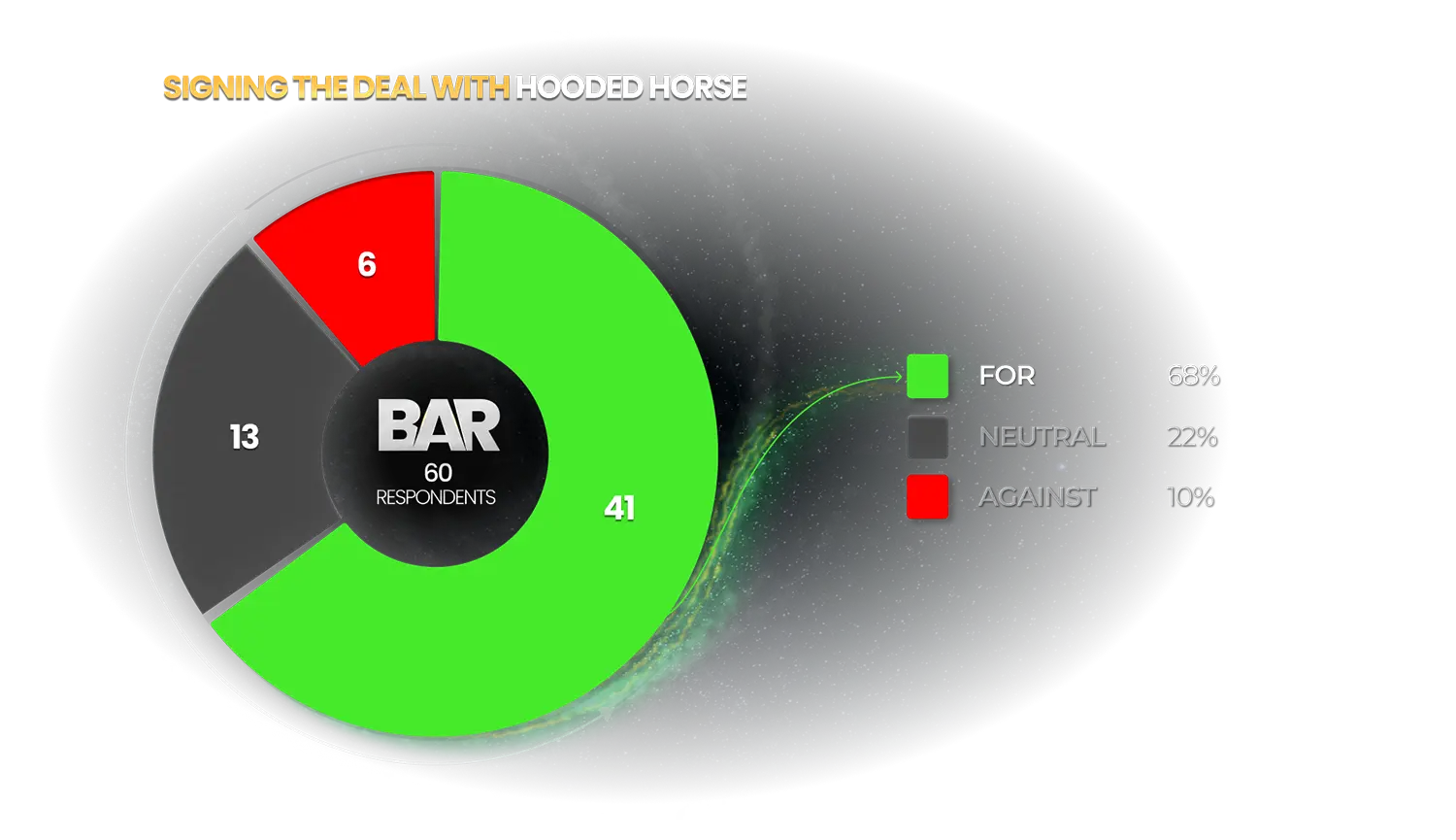
The result was a clear supermajority in favour, a meaningful neutral group, and a small group against.
Going into this, we accepted that no version of the deal would feel right to every single contributor. We needed to set a threshold for what level of support we would treat as a real mandate, and the contributor team cleared it with a significant margin.
The second question asked whether contributors intend to keep working on BAR if the deal goes ahead.
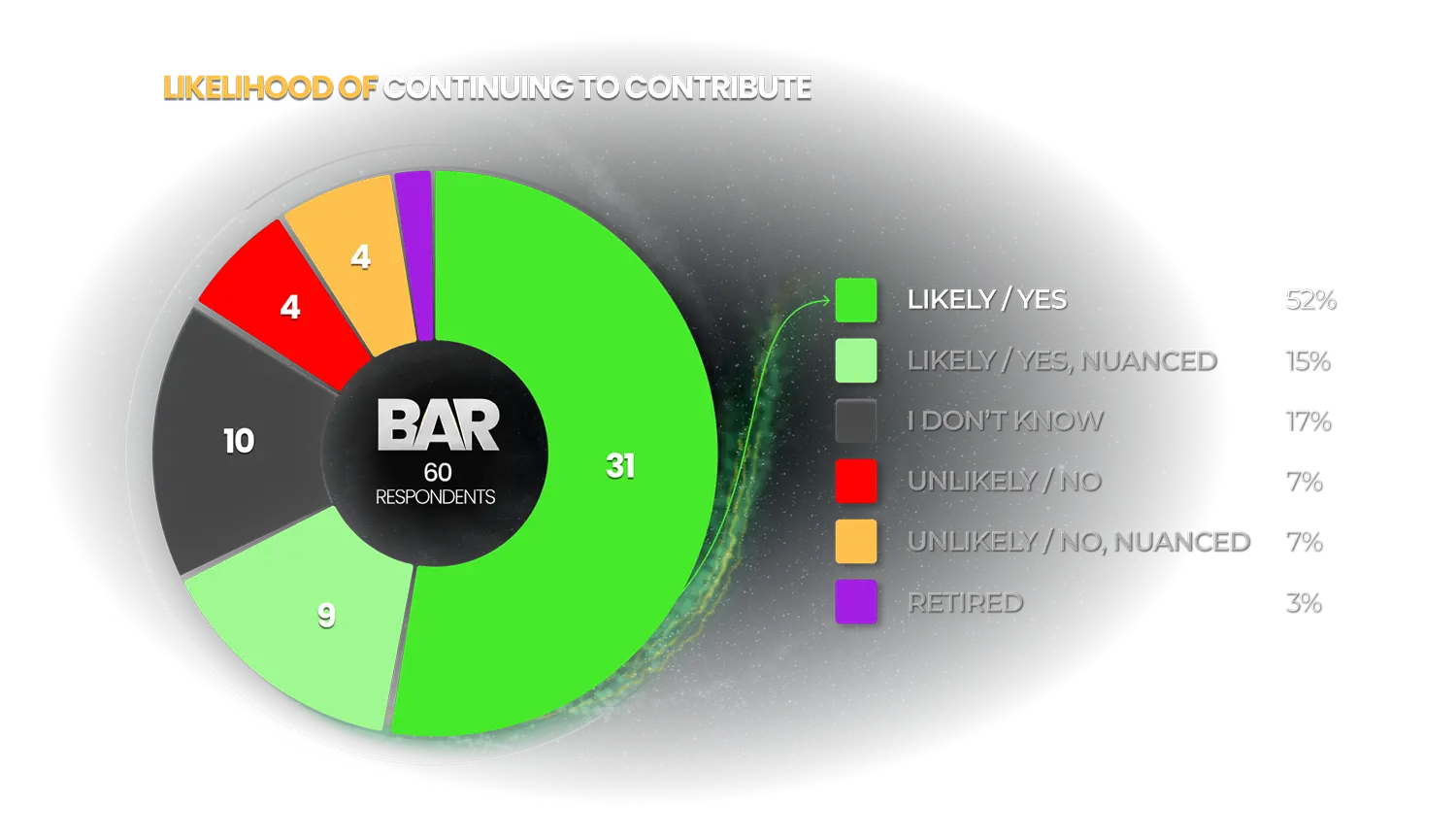
This mattered a lot to us. One of our biggest worries going into the process was that the transition could cost the project a large part of its contributor base.
The result was much more positive than we expected. Most respondents intend to keep contributing, including some people who voted against the deal itself. That tells us the team may not agree on every detail, but most people still want BAR to succeed and still want to be part of making that happen.
Taking the survey, the discussions, and the voice meetings together, the team is cautiously optimistic. People understand why this is happening, broadly support the direction, and are giving us the trust needed to handle the transition responsibly. We know that trust has to keep being earned as we go.
There is not much that changes from a day-to-day perspective for you, Commanders. We keep maintaining the free project, running multiplayer servers, and fostering the great community around it through events, tournaments, and regular updates.
Most of the change you will eventually notice is in the pace of development as we onboard more team members and ramp up production. There are great things ahead on our roadmap, and even though we will be working quietly on some massive milestones that are meant to be released all at once (the new client migration, the faction visual rework, the campaign), there will be tons of smaller improvements that trickle down to benefit the free community as we go.
One thing that will become apparent after a while is that BAR is now maturing into a more defined experience, converging on a clearer set of gameplay and audiovisual designs. This is a prerequisite for campaign work to progress without constantly having to rework completed missions. It does not mean the gameplay becomes stale. We will keep balancing it to provide interesting freshness in the meta, without stepping on the Campaign Team's toes.
In practice, the sharp design changes get frontloaded in the production plan. Big disruptive projects like the transports rework happen in a specific window so that once mission production starts, the design underneath stays stable. After that window, changes ramp down to the kind of subtle balance patches that keep things fresh without causing issues for the campaign work.
With the gameplay design converging, proper modability becomes more important for the folks who want to do things differently from vanilla, and we plan to support that as best we can.
A dedicated team also lets us upgrade a lot of our current processes and professionalise the project further. Expect to see better-organised events, more professional tournament coverage, and stronger community management as that work progresses.
There are no abrupt changes coming; instead you should expect a steady acceleration towards release.
We want to share our deepest gratitude with everyone who has been on this journey with us. The contributor team, the players, the mentors, the moderators and the Overwatch team, our amazing content creators, translators, supporters and everyone who has been following the project and putting trust in us and the direction we set for the project. We are here because of you, and we are doing this for you. We have been extremely lucky to find ourselves among people who, even coming from different backgrounds and holding different values, all align on one common goal: to create the best real-time strategy experience of all time.
It is an incredible position to be in. Some of us have been here for literal decades, driven by the same ember of passion. Now we get to make BAR not only our hobby but also our career, and give the project we love this much the care and exposure it deserves. We cannot imagine a better place to be.
Let's keep this fire of passion and unity burning as we open this new chapter in the long history of Beyond All Reason. Together.
Commanders, it is with enormous excitement, and a fair bit of disbelief that we are finally writing this post, that we can announce Beyond All Reason has officially signed a publishing partnership with Hooded Horse and is going professional!
Almost seven years of community-driven development, more than 150 contributors pouring incredible amounts of time and care into this project, and a community that has grown into one of the most active in the entire RTS space. It is time to take it one step further and secure a successful release and longevity of the project for years to come.
If you have been following recent developments in our community channels, you may already know that we have been discussing a potential publishing deal internally with the Contributor Team. We realise this may come as a very unexpected shift to many of you, so we would like to take the utmost care to explain why we took this step, what it means for the future of the project, our development team, and the community.
For those of us on the admin team, this announcement has been a long time in the making. A lot of time went into conversations with publishers, lawyers, advisors, and our contributor team, trying to work out whether there was a way to take BAR to its full potential without compromising what makes it special. The honest truth is that for a while, we were not sure such a path existed. The fact that we are publishing this announcement at all, with a partner that genuinely fits and a structure that protects what BAR is at its core, still feels slightly surreal as we type this.
Without further ado, let us cut to the chase and break down what the Tick is going on!
TLDR: Read post summary
Many of you seeing this headline are probably immediately wondering about that.
After all, the volunteer-only model has carried Beyond All Reason to greatness. The game is doing well, the community is growing, we have just presented the lore and worldbuilding for the campaign, we are regularly releasing updates, and it can look like the project is already moving forward at a solid pace.
At the same time, anyone looking closely at our Steam Release Roadmap may notice that many of the biggest things we aspire to bring for release are still a long way ahead.
So where does this paradox come from? Why is the project so alive and actively moving forward, while the Steam release can still feel so far over the horizon?
The honest answer is that the volunteer-only model has a very specific character.
It is incredibly good at the work people are personally excited to do in their free time: new unit ideas, balance changes, beautiful maps, lore, gameplay experiments, events, tournaments, and countless other things that have made BAR what it is today. The amount of passion and craft this community has poured into the game over the years is genuinely remarkable.
But a full Steam release depends on a different kind of work: long, sustained, often unglamorous effort that has to be owned from start to finish. A new client, a coherent campaign, scalable, reliable infrastructure, onboarding, QA, polish, release coordination. None of these are impossible, but they require focused time, accountability, and people whose job it is to carry them through, not just contribute to the parts they enjoy after work.
That is the paradox. BAR is alive and moving fast because volunteers keep creating amazing things. The Steam Roadmap still feels far away because many of its biggest items are exactly the kind of work the volunteer-only model struggles to finish.
We have been hitting this wall for a long time, and we have tried many ways around it. Looking honestly at the road ahead, the volunteer-only path would likely put a proper Steam release another three to five years away from where we stood at the start of 2026.
We did not want to keep telling the community “soon” while knowing that, structurally, it was not entirely true.
The window for BAR to make a real impact in the RTS world is not eternal. We did not want to look back years from now at a game that was “almost ready”, knowing we had a chance to do this properly and chose not to.
At the same time, as may be a surprise to some and obvious to others, BAR has been getting noticed in the games industry for a while now. Over the past couple of years we have had a surprising number of publishers reach out to us with offers. It is an incredibly privileged position in today’s industry to be in, having so many options. Most we politely declined. The structure of a typical publishing deal is shaped around a particular kind of game and a particular kind of studio, and very little of that shape fits a project like BAR.
We did not want to fold ourselves into a model that would slowly chip away at what made BAR worth doing in the first place.
One offer, however, came in looking completely different. The shape of it was closer to what we would have asked for if we had been able to write our own dream contract than anything else we had seen, and the values behind it lined up with the spirit of the project in ways we had stopped expecting to find. So we dug in.
Before we get into what is actually in this deal and why it fits BAR so well, let us introduce the publisher!
If you play strategy games on Steam, you very probably already know their work. Hooded Horse is a publisher specialising entirely in strategy, simulation, and role-playing games, and their catalogue is a who's-who of recent indie hits in the genre: Manor Lords, HOMM: Olden Era, Terra Invicta, Against the Storm, Old World, and a long list of others.
What is interesting about Hooded Horse is how young the company itself actually is. Founded in 2019 by Tim Bender (CEO) and Snow Rui (President), the same year the modern incarnation of BAR development began, they have grown from a tiny operation into one of the most respected publishers in the strategy space in just a few years. The team is still relatively small at a little over 30 team members, with each member a specialist in a particular subgenre they personally play.
They have built one of the cleanest reputations of any publisher operating in this space, known for being hands-off on creative direction, unusually transparent about how they work, and genuinely respected by the developers they have partnered with. A meaningful part of that reputation comes from how their business model is structured. Hooded Horse pays developers from the first dollar of sales rather than trapping them in the recoupment cycle that still dominates a lot of indie publishing. Each game they take on gets a guaranteed marketing investment regardless of its commercial trajectory. The model is built around developer success rather than extraction. Having looked at a lot of publishing models over the past year, we can confirm this is genuinely rare in this industry.
After spending many months in discussions with Tim and the wider Hooded Horse team, also recently having them meet our Contributor Team we can say with full confidence this reputation carries through in how they approached our project and in what we put on paper.
Let's get straight to the questions everyone is going to ask and explain what this deal entails and what it means for BAR’s future.
The question many of you will be asking by now is "well, what's in it for the publisher?" BAR comes from a community-driven, open-source lineage, and has always been free. How do we turn it into a commercial venture without breaking the spirit of what we have built?
This is genuinely the most interesting part of the deal, and we were able to align on a monetisation model that historically has only been tried by a small handful of games.
The model we landed on with Hooded Horse is, in simple terms, this:
BAR’s multiplayer and all current content stays free exactly as available now through the website version. In addition, we’ll be using the funding from the publishing deal as well as revenue from sales to improve the multiplayer experience, with these improvements offered for free as well.
The Steam release will be paid, and aside from the multiplayer experience, it will also feature additional singleplayer content. The multiplayer game will be the same on Steam, with full feature parity and cross-play. Same matchmaking, same servers, same community-built content.
Nothing that is free today gets taken away or put behind a paywall, and what is free will be continuously improved as well.
And that part matters a lot. BAR is an incredible multiplayer game, and everyone here knows that, but a huge part of the RTS audience comes primarily for single-player. For many people discovering BAR on Steam, the campaign will be their first real impression of the game. We do not want that to be “a few scenarios with story text attached”. We want it to feel like a real campaign: coherent, atmospheric, story-driven, and worthy of the world we have been building.
We know some people expected BAR to remain completely free in every possible form forever, so we understand why this may feel like a big shift. We did not take that lightly.
The important part is that the funding does not only go into paid content. A lot of it goes into things that improve BAR for everyone: the new client, better infrastructure, visual polish, onboarding, matchmaking, tutorials, QA, localisation, accessibility, and a long list of other work that the whole game needs regardless of edition.
The free version becomes a much better game because this deal exists.
To be clear about the usual fears that come with anything commercial: we intend to base BAR around a premium sale price for the full game, and then any paid expansions that might come later would be substantial additional content, there is not going to be any pay to win, ad placements, or similar. We are gamers ourselves first, and we hate that stuff in the games we play as much as anyone reading this does. We are not going to do it to BAR. The closest reference point is probably Mindustry: a free open-source game kept intact, with a paid Steam version on top for people who want that route. We are taking a similar general shape, adapted to BAR and to the scale of what we want to build.
So if you have been playing BAR for free for a few days or for years and years, the short version is: nothing gets taken away.
You keep the game you already have, you benefit from the improvements made possible by the funding, and you can choose whether you want to go further with the Premium Edition to experience the full campaign or stay entirely on the free side.
The other unique aspect of the deal we were able to achieve is how it protects the future of the project as a community driven game:
Donations stay community-facing. Donations to BAR continue, walled off from the commercial side. They are being formalised as a community fund covering tournament prize pools, community events, contributor tooling, server safety net, and similar community-facing spending. The publishing funding covers commercial development. The two never mix. More on the community fund mechanism in a follow-up post.
The biggest practical change is that BAR development is going professional.
The publishing funding lets us hire full-time personel into the areas that have been bottlenecking the project for years: client and infrastructure work, campaign content production, project management, QA, polish, release coordination, and other roles that could never really be sustained on volunteer time alone.
Before signing, we wanted to be sure the funding actually matched the ambition. We now have the production plan and budget breakdown, and the answer is yes. There is enough funding to cover pretty much all of our main aspirations for the Steam release in a reasonable timeframe.
That is still a bit surreal to write. Six months ago, we could not have said this. We can’t wait to present the updated roadmap to the community! :)
A huge priority for us is making sure this transition does not lose what made BAR special in the first place. Wherever we need someone full-time and there is an existing contributor already doing great work in that area, that person is first in line. That has been our internal commitment from the start.
The volunteer side of BAR keeps going. People can still contribute in the same way they always have, on the parts they care about and enjoy working on. The funded side finally gives us a way to take on the heavy, continuous, deadline-sensitive work that has been waiting for proper ownership for a long time.
Before anything was signed, we put the deal in front of the people who build BAR.
Over several weeks, contributors read the proposal, discussed it in threads, joined voice meetings, asked Hooded Horse questions directly, challenged us on the parts they were uncomfortable with, and gave a lot of detailed feedback.
There was broad support for working with Hooded Horse, but there were also serious concerns about the ownership structure, the volunteer-to-paid transition, and the social dynamics that come from paid and unpaid contributors working side by side on the same project.
We took those concerns seriously enough to amend the original proposal during the consultation period. The deal we are announcing now is better than the one we started with, because contributors pushed on the right things.
The final mandate question had two parts: The first asked whether contributors support the deal.
The result was a clear supermajority in favour, a meaningful neutral group, and a small group against.
Going into this, we accepted that no version of the deal would feel right to every single contributor. We needed to set a threshold for what level of support we would treat as a real mandate, and the contributor team cleared it with a significant margin.
The second question asked whether contributors intend to keep working on BAR if the deal goes ahead.
This mattered a lot to us. One of our biggest worries going into the process was that the transition could cost the project a large part of its contributor base.
The result was much more positive than we expected. Most respondents intend to keep contributing, including some people who voted against the deal itself. That tells us the team may not agree on every detail, but most people still want BAR to succeed and still want to be part of making that happen.
Taking the survey, the discussions, and the voice meetings together, the team is cautiously optimistic. People understand why this is happening, broadly support the direction, and are giving us the trust needed to handle the transition responsibly. We know that trust has to keep being earned as we go.
There is not much that changes from a day-to-day perspective for you, Commanders. We keep maintaining the free project, running multiplayer servers, and fostering the great community around it through events, tournaments, and regular updates.
Most of the change you will eventually notice is in the pace of development as we onboard more team members and ramp up production. There are great things ahead on our roadmap, and even though we will be working quietly on some massive milestones that are meant to be released all at once (the new client migration, the faction visual rework, the campaign), there will be tons of smaller improvements that trickle down to benefit the free community as we go.
One thing that will become apparent after a while is that BAR is now maturing into a more defined experience, converging on a clearer set of gameplay and audiovisual designs. This is a prerequisite for campaign work to progress without constantly having to rework completed missions. It does not mean the gameplay becomes stale. We will keep balancing it to provide interesting freshness in the meta, without stepping on the Campaign Team's toes.
In practice, the sharp design changes get frontloaded in the production plan. Big disruptive projects like the transports rework happen in a specific window so that once mission production starts, the design underneath stays stable. After that window, changes ramp down to the kind of subtle balance patches that keep things fresh without causing issues for the campaign work.
With the gameplay design converging, proper modability becomes more important for the folks who want to do things differently from vanilla, and we plan to support that as best we can.
A dedicated team also lets us upgrade a lot of our current processes and professionalise the project further. Expect to see better-organised events, more professional tournament coverage, and stronger community management as that work progresses.
There are no abrupt changes coming; instead you should expect a steady acceleration towards release.
We want to share our deepest gratitude with everyone who has been on this journey with us. The contributor team, the players, the mentors, the moderators and the Overwatch team, our amazing content creators, translators, supporters and everyone who has been following the project and putting trust in us and the direction we set for the project. We are here because of you, and we are doing this for you. We have been extremely lucky to find ourselves among people who, even coming from different backgrounds and holding different values, all align on one common goal: to create the best real-time strategy experience of all time.
It is an incredible position to be in. Some of us have been here for literal decades, driven by the same ember of passion. Now we get to make BAR not only our hobby but also our career, and give the project we love this much the care and exposure it deserves. We cannot imagine a better place to be.
Let's keep this fire of passion and unity burning as we open this new chapter in the long history of Beyond All Reason. Together.
For those who do not have time to read the full thing right now, here are the essentials:
The rest of this post explains all of the above in detail, plus what happens next, and what this means for the community.